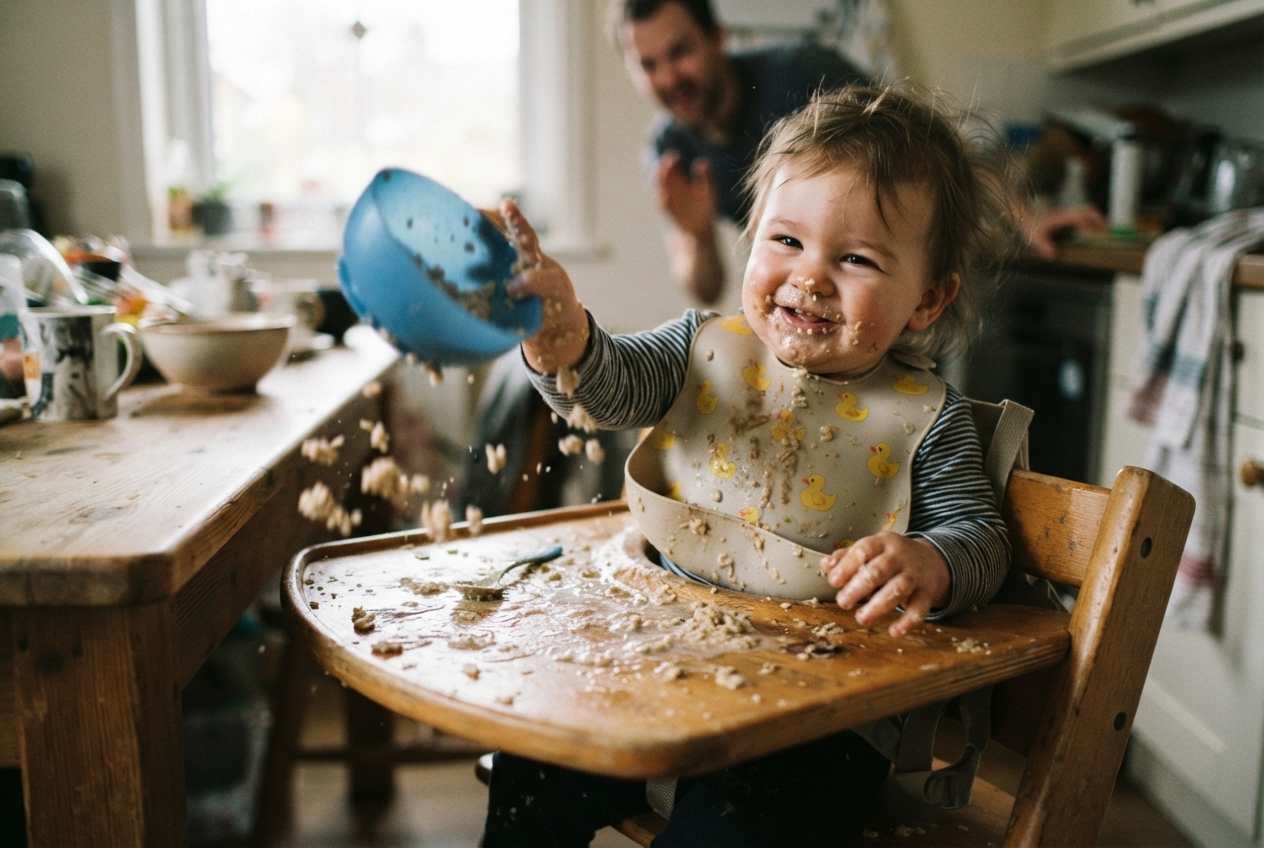
At its peak last fall, Margot’s bowl-throwing was not a phase, it was a skill. Good arc, consistent release, and she had developed a targeting system: if you were approaching with the spoon, the throw came early; if you said “all done” too fast, direct hit. There is oatmeal in the grout above the stove that we have collectively agreed is part of the house now.
The standard advice — “give her words for her feelings” — is correct and useless in the moment, because the moment a three-year-old is winding up for a throw is not a moment for vocabulary lessons. Here’s what actually moved the needle, over roughly three months and, by rough count, eleven bowl incidents.
Step one: stop the physics, not the feeling
Every meal got restructured so that the projectile option didn’t exist. Margot’s bowl became a silicone bowl with a suction base that survives a direct assault from a three-year-old. Her cup got a lid even though she “doesn’t need one” (she needed one). Fork and spoon went on the tray only when food was on them.
This isn’t about punishment or removing agency. It’s about not running the same experiment forty more times and expecting a different result. You cannot teach “use your words” in an environment engineered for throwing. You engineer the environment first, then teach in it.
Step two: narrate like a sportscaster, then give the sentence
When the frustration showed up — and it always showed up, it just had nowhere to go — we narrated it flat and gave her the exact sentence, every single time, same words:
“You’re mad. You can say: I’M MAD.”
Not “use your words.” Not “we don’t throw.” Those are instructions; she can’t follow instructions at that temperature. She needs the sentence handed to her, fully built, two words long. Say it for her, loudly enough to be usable, and then wait.
For about six weeks she never used it. She screamed, she pushed the tray, she once attempted to throw the suction bowl, base and all, which is a deadlift, not a throw, and honestly impressive. We kept handing her the sentence anyway. The sentence is the seed; you don’t get to watch it germinate on your schedule.
“Use your words” is a demand. “You can say: I’m mad” is a gift. Toddlers take gifts; they resist demands. Same idea, completely different delivery.
Step three: celebrate the sentence, not the silence
The first time Margot said it — December 9th, I remember because it was the night my mother visited and watched the whole thing like a tennis match — she said “I’M MAD” at a volume that could have been heard two streets over, and then looked startled by her own sentence.
Our response was calibrated and slightly absurd: no applause (that turns a feeling into a performance), but immediate, total attention. “You said it! You’re mad. The oatmeal is too hot. Let’s blow on it.” The feeling got taken seriously because the sentence arrived. Within two weeks the sentence was routine. Within six, mostly automatic.
Is the throwing gone forever? No. Last Tuesday a bowl left the tray when she was sick and exhausted and I pushed the peas thing too far. It happens. But the ratio has flipped: the sentence is the default and the throw is the outlier, and that’s the whole game at three.
What I’d tell myself in October
Three things, short:
- The suction bowl is not a defeat. It’s the difference between teaching in a storm and teaching in a room.
- Two words, same words, every time. Consistency is the only actual ingredient. Margot didn’t need a bigger vocabulary; she needed one reliable sentence that worked.
- Six weeks of nothing is normal. You are building a road in the dark. Keep handing her the sentence.
Nora, meanwhile, is two and has watched this entire curriculum from her chair like a graduate student. Last week, frustrated with a banana that broke in half (a tragedy in any house), she said, quite calmly, “I’m mad.” No bowl involved. Margot, from across the table: “She learned it from me.” She did. She absolutely did.