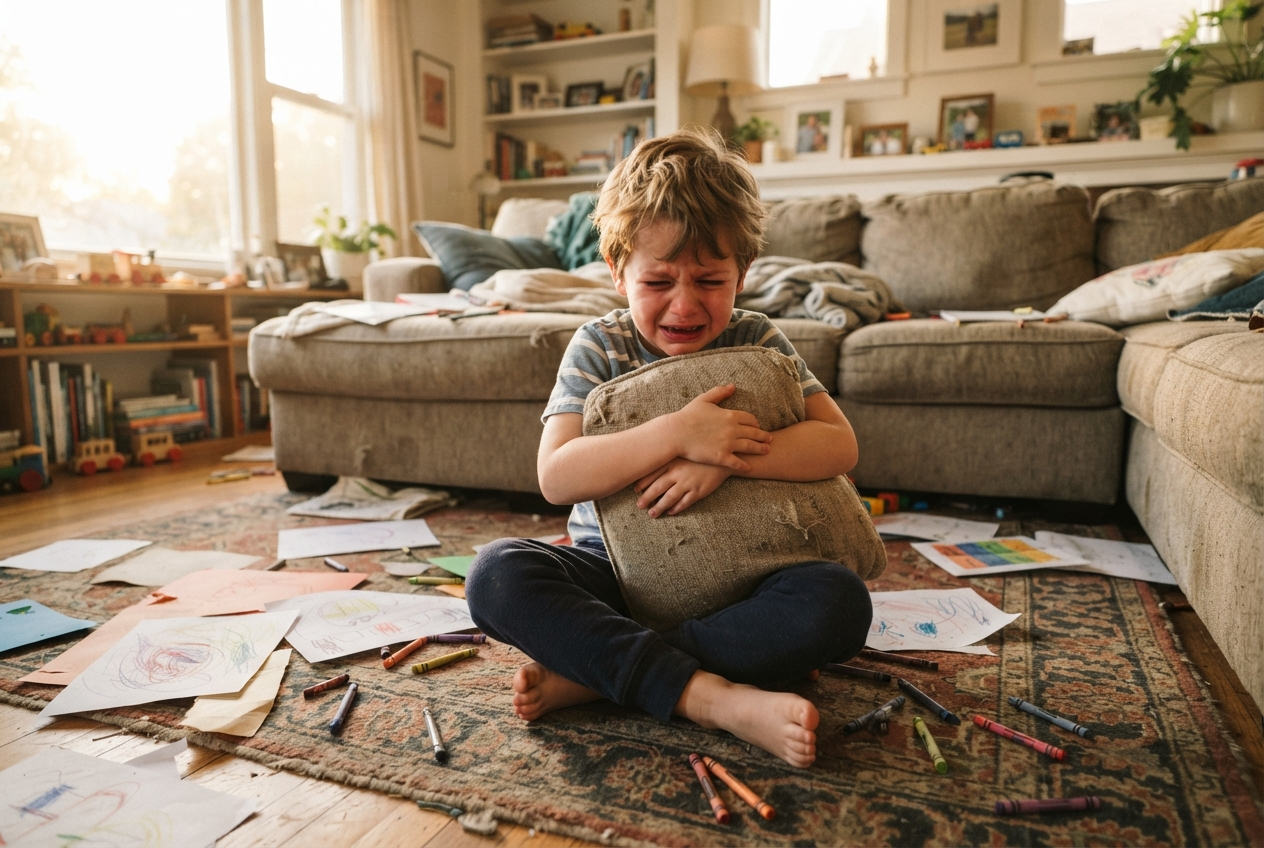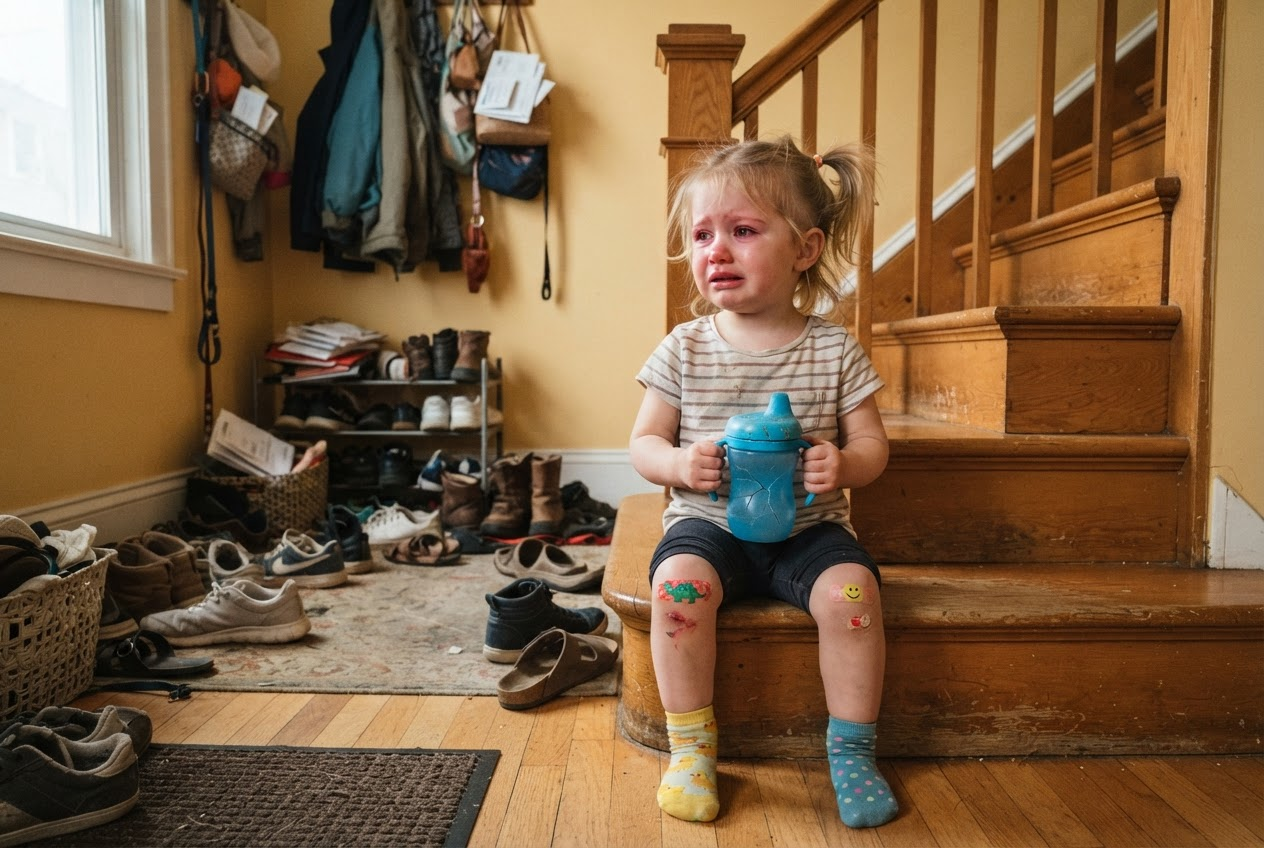
Here is a scene from our house roughly four times a day: Nora, two and three-quarters (she is emphatic about the three-quarters), trips over the rug, over the cat, over her own ambition. There is a pause. In that pause, before anyone has spoken, Nora looks directly at me. She is checking my face to find out what just happened to her.
For a long time, my face said panic, and my mouth said, “Are you okay? Are you okay?!” And Nora, who until that moment had been mildly evaluating the situation, would receive my horror, agree with it, and scream. Not fake-scream. A real scream, because I had just told her with my entire being that this was a screaming event.
The pause is the whole thing
Kids that age don’t fall and instantly have a verdict. They fall, and then they look for one. The pause between the fall and the feeling is real, and it is shockingly long — sometimes two full seconds. Whatever you pour into that pause becomes the story.
We didn’t invent this observation; our pediatrician mentioned it in passing during Nora’s two-year visit, between weight checks and a discussion of why she only eats beige foods. But once you see the pause, you can’t unsee it. Felix at five still does a version of it — he skins his knee, looks over, and if I’m already wincing, the tears arrive on schedule.
The question “Are you okay?” sounds like comfort, but it’s actually a verdict delivered in the form of a question — and most of the time, we’re delivering it before the kid has even finished falling.
What we say instead
We replaced the question with a flat, boring, sportscaster narration. Some rotation of:
- “Oops. You fell.”
- “Your knee hit the floor.”
- “Take your time. I’m right here.”
That’s it. No gasp, no sprint across the room unless there’s blood or a head involved, and — this is the hard part — no face. My face has to say that was a fall, falls happen, we’ll see what happens next.
The first week felt insane. My child is on the floor and I’m supposed to say “you fell” like a weather report? But the results were not subtle. Within about ten days, maybe half of Nora’s falls ended with her getting up, brushing her knees, and saying “I falled” — her grammar, her verdict — and continuing toward whatever she was doing before gravity interrupted.
The other half still end in tears, and those tears are real and get real comfort. That’s the part I want to be careful about here: this isn’t a trick to produce a kid who never cries. It’s about not assigning the cry before the kid has checked in with her own body.
The scraped-knee test
The real test came in January, at the playground by the library — the one with the wood chips that are either a safety feature or an agricultural project, depending on the day. Nora came off the low climber full-length, palms and knees into the chips, a genuine scrape with genuine blood.
I walked over at a normal pace. I said, “You fell off. That scrape looks like it stings.” She looked at her knee, looked at me, and said, “It needs a bandage and a snack.” Both true. We did both. There were tears, but they were her tears — the tears of a person who has assessed an injury and determined it merits tears — not an echo of mine.
Margot, three, watched the whole thing and said, “Nora’s very brave,” which is either sweet or the start of a family mythology I can’t control.
What it isn’t
I want to say this plainly, because I’ve watched this advice get flattened into “ignore your kid”: we did not stop comforting Nora. We stopped pre-writing the story of every fall. When she’s hurt, she gets held, bandaged, and narrated with total sincerity. When she’s not, she gets the dignity of getting up unremarked.
Two and three-quarters is an age of enormous, unannounced competence. She climbs, she recovers, she gets up. The least we can do is let her find out she’s okay before we tell her she isn’t.